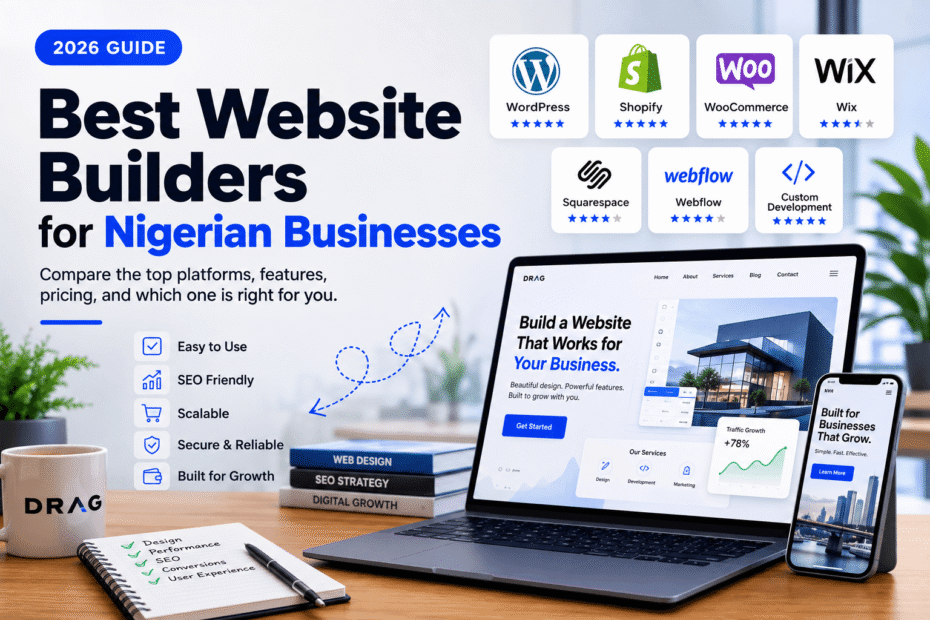
Choosing the right website builder is one of the most important decisions you’ll make for your business.
Your website isn’t just an online brochure—it can become your best salesperson, customer service representative, and marketing tool.
With so many platforms available today, it’s easy to feel overwhelmed.
- Should you choose WordPress?
- Is Shopify better for online stores?
- Is Wix enough for a small business?
- Should you invest in a custom-built website instead?
In this guide, we’ll compare the best website builders for Nigerian businesses, their strengths, weaknesses, pricing, and which businesses they’re best suited for.
By the end, you’ll know exactly which platform matches your goals.
Quick Comparison
| Platform | Best For | Ease of Use | SEO | eCommerce | Scalability |
|---|---|---|---|---|---|
| WordPress | Most businesses | ★★★★☆ | ★★★★★ | ★★★★★ | ★★★★★ |
| Shopify | Online stores | ★★★★★ | ★★★★☆ | ★★★★★ | ★★★★☆ |
| WooCommerce | WordPress stores | ★★★★☆ | ★★★★★ | ★★★★★ | ★★★★★ |
| Wix | Beginners | ★★★★★ | ★★★☆☆ | ★★★☆☆ | ★★☆☆☆ |
| Squarespace | Creatives | ★★★★★ | ★★★★☆ | ★★★☆☆ | ★★★☆☆ |
| Webflow | Designers | ★★★☆☆ | ★★★★★ | ★★★☆☆ | ★★★★☆ |
| Custom Website | Large businesses | ★☆☆☆☆ | ★★★★★ | ★★★★★ | ★★★★★ |
What Should You Look for in a Website Builder?
Before choosing a platform, consider:
- Is it easy to update?
- Does it support SEO?
- Can it grow with your business?
- Is it mobile-friendly?
- Can it accept online payments?
- Does it load quickly?
- Can it integrate with marketing tools?
- What’s the long-term cost?
The best platform isn’t necessarily the most popular—it’s the one that fits your business needs.
1. WordPress
Best For
- Small businesses
- Corporate websites
- Service businesses
- Blogs
- Educational websites
- Membership websites
Advantages
- Highly customizable
- Excellent SEO capabilities
- Thousands of plugins
- Huge community support
- Easy to scale
- Own your website and data
Disadvantages
- Requires occasional updates
- Can become slow if poorly built
- Plugin quality varies
Best For Nigerian Businesses?
Absolutely.
For most businesses in Nigeria, WordPress offers the best balance of flexibility, affordability, and long-term growth.
2. Shopify
Best For
Businesses focused on selling products online.
Advantages
- Easy to manage
- Secure
- Fast
- Reliable hosting included
- Excellent checkout experience
- Built-in payment support
Disadvantages
- Monthly subscription
- Transaction fees in some cases
- Less flexible than WordPress for non-store websites
If your business primarily sells physical products, Shopify is a strong option.
3. WooCommerce
WooCommerce is an eCommerce plugin built for WordPress.
It combines the flexibility of WordPress with powerful online store functionality.
Advantages
- Complete ownership
- Highly customizable
- Great SEO
- Thousands of extensions
- No platform lock-in
Ideal For
Businesses that want complete control over their online store.
4. Wix
Wix is one of the easiest website builders for beginners.
Advantages
- Drag-and-drop editor
- Fast setup
- No coding required
- Hosting included
Disadvantages
- Limited scalability
- Less flexibility
- Migrating away can be difficult
Wix works well for freelancers and very small businesses with simple needs.
5. Squarespace
Squarespace is known for professionally designed templates.
Best For
- Photographers
- Designers
- Artists
- Restaurants
- Personal brands
Advantages
- Beautiful templates
- Easy editing
- Hosting included
- Good blogging features
Limitations
Less customizable than WordPress for complex projects.
6. Webflow
Webflow has become increasingly popular among designers and agencies.
Advantages
- Visual development
- Clean code output
- Excellent animations
- Strong performance
- Good SEO controls
Disadvantages
- Steeper learning curve
- More expensive than some alternatives
- Less familiar to non-technical users
Ideal for businesses that prioritize custom design and modern interactions.
7. Custom-Built Websites
Some businesses need features that no website builder can provide.
Examples include:
- Booking platforms
- Customer dashboards
- Marketplaces
- SaaS products
- CRMs
- Learning management systems
- Internal business tools
These are typically built using frameworks such as Laravel or React.
Advantages
- Unlimited flexibility
- Tailored to your processes
- High scalability
- No unnecessary features
Disadvantages
- Higher initial investment
- Longer development time
- Requires ongoing maintenance
Which Website Builder Is Best for SEO?
If search engine visibility is important, here is a general ranking:
Remember, the platform alone doesn’t guarantee rankings. Your content quality, technical setup, page speed, and backlink profile matter much more.
Which Platform Is Best for eCommerce?
| Business Type | Recommended Platform |
|---|---|
| Small Online Store | Shopify |
| Growing Brand | WooCommerce |
| Enterprise Store | Custom Development |
| Marketplace | Custom Development |
Choose based on your business model and long-term plans.
Which Website Builder Is Best for Beginners?
If you have no technical experience:
- Wix
- Squarespace
- Shopify
These platforms offer straightforward setup and maintenance.
Website Builders vs Custom Development
Many business owners eventually outgrow DIY website builders.
A custom-built website offers:
- Better performance
- More flexibility
- Unique branding
- Custom functionality
- Easier integration with business systems
For companies planning long-term growth, custom development is often the better investment.
Common Mistakes to Avoid
- Choosing based only on price
- Ignoring SEO capabilities
- Not considering future growth
- Selecting a platform that doesn’t support your business goals
- Overlooking ongoing maintenance costs
Take time to evaluate both your current needs and where your business will be in two or three years.
Frequently Asked Questions
Which website builder is best for Nigerian businesses?
For most small and medium-sized businesses, WordPress offers the best balance of flexibility, SEO, scalability, and ownership.
Is Shopify available in Nigeria?
Yes. Nigerian businesses can use Shopify and integrate supported payment gateways, though available options may differ depending on the provider and region.
Can I build a professional website without coding?
Yes. Platforms like WordPress, Shopify, Wix, and Squarespace allow you to create and manage websites with little or no coding knowledge.
Which platform is best for SEO?
WordPress and Webflow provide excellent SEO capabilities when configured properly, but rankings depend on the overall quality of your website and content.
Should I choose a website builder or a custom website?
If your needs are straightforward, a website builder may be enough. If you require unique features, complex integrations, or expect significant growth, custom development is usually the better long-term choice.
Final Recommendation
There is no single “best” website builder for everyone.
- If you run a service business, WordPress is an excellent choice.
- If you sell products online, Shopify or WooCommerce are strong contenders.
- If you need advanced business functionality, consider custom development.
The right platform should support your business today while giving you room to grow tomorrow.
Why Businesses Choose DRAG
At DRAG, we don’t believe in a one-size-fits-all approach. We help businesses choose the platform that best fits their goals, budget, and growth plans.
Whether you need a high-performing WordPress website, a scalable WooCommerce store, a Shopify setup, or a custom web application, we focus on creating websites that are fast, secure, SEO-friendly, and built to generate results.
Our process includes strategy, design, development, optimization, and ongoing support, so your website continues to work for your business long after launch.
Related Articles
Strengthen your topical authority by linking to: