Artificial intelligence has gone from being an interesting technology to becoming a practical business tool.
Today, a small business can use AI to:
- Write and edit content
- Research markets and competitors
- Analyze spreadsheets
- Create presentations
- Design marketing materials
- Automate repetitive tasks
- Respond to customers
- Generate leads
- Write code
- Analyze business data
- Create images and videos
- Build internal workflows
- Conduct research
- Manage knowledge
The challenge is no longer “Can AI help my business?”
The challenge is:
Which AI tools are actually worth using?
There are thousands of AI products competing for your attention, and many of them solve problems you don’t actually have.
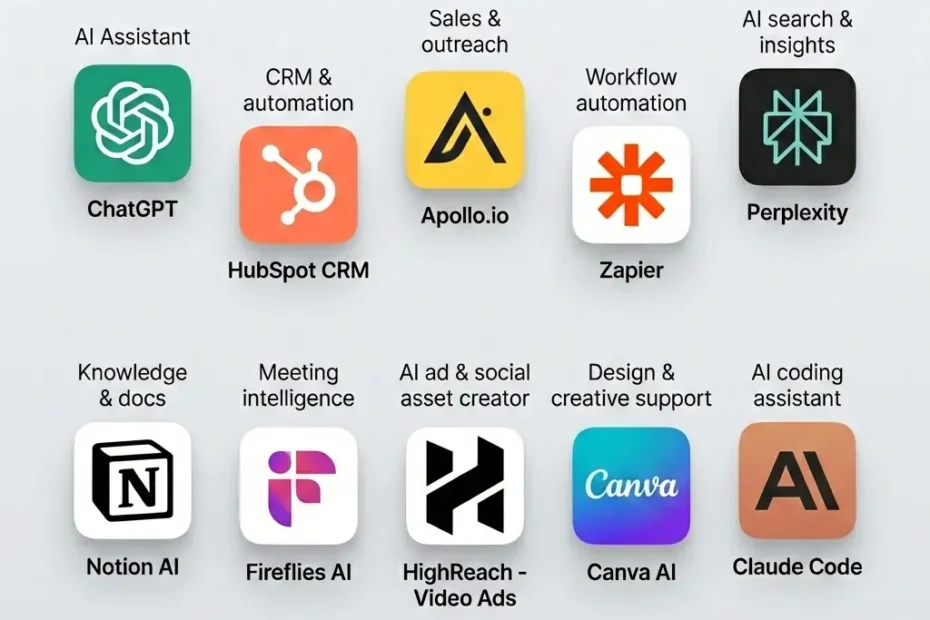
This guide breaks down some of the best AI tools for businesses in 2026, what they’re good at, who should use them, and where they fit into a modern business workflow.
Quick Answer: The Best AI Tools for Businesses
If you don’t want to read the entire guide, here’s the shortlist:
| Tool | Best For | Best Business Use |
|---|---|---|
| ChatGPT | General business AI | Research, writing, analysis, strategy, automation |
| Claude | Writing & analysis | Documents, research, reasoning |
| Google Gemini | Google ecosystem | Research, Workspace, productivity |
| Microsoft Copilot | Microsoft 365 | Word, Excel, PowerPoint, Outlook, Teams |
| Perplexity | AI research | Research and information discovery |
| Canva | Design | Marketing graphics, presentations, social content |
| Notion AI | Knowledge & productivity | Documentation, meetings, project management |
| Zapier | Automation | Connecting apps and automating workflows |
| GitHub Copilot | Software development | Coding and developer productivity |
| Adobe Firefly | Creative work | Images and creative production |
There isn’t one AI tool that’s best at everything.
The best approach is to build an AI stack around the actual needs of your business.
What Should Businesses Look for in an AI Tool?
Before subscribing to another AI product, ask five questions:
1. What problem does it solve?
Don’t adopt AI simply because everyone is talking about it.
Start with the business problem.
2. How much time does it save?
If a tool saves your team 10 hours every month, its value is easy to understand.
3. Does it improve quality?
Speed isn’t useful if the final result is worse.
4. Does it integrate with your existing tools?
An AI tool becomes significantly more valuable when it can work with your existing systems.
5. Can your business use it safely?
Consider:
- Data privacy
- Access controls
- Company information
- Customer information
- Intellectual property
- Employee permissions
AI adoption should be intentional, especially when employees are using AI with business data.
1. ChatGPT
Best Overall AI Tool for Businesses
OpenAI’s ChatGPT is one of the most versatile AI tools available to businesses.
It can support everything from research and writing to data analysis, coding, marketing, customer support, and workflow automation.
OpenAI’s current business offering includes ChatGPT, ChatGPT Work, Codex, connected business tools, data analysis, and workspace agents. OpenAI
What businesses can use ChatGPT for
- Writing
- Research
- Brainstorming
- Data analysis
- Creating reports
- Marketing
- Sales research
- Customer support
- Coding
- Documentation
- Strategy
- Content creation
- Workflow automation
For teams, ChatGPT Business provides a shared workspace with centralized administration and business controls. OpenAI Help Center
Best for
Almost every type of business.
If you’re only going to introduce one general-purpose AI tool into a small business, ChatGPT is a strong starting point.
2. Claude
Best for Writing, Documents and Deep Analysis
Anthropic’s Claude is particularly useful for businesses working with large amounts of written information.
It can be used for:
- Writing
- Editing
- Document analysis
- Research
- Summarization
- Strategy
- Coding
- Brainstorming
Claude can be particularly useful for teams that spend a lot of time working with proposals, policies, reports, research documents and other long-form material.
Best for
- Consultants
- Agencies
- Researchers
- Legal teams
- Marketing teams
- Writers
- Product teams
3. Google Gemini
Best for Businesses Using Google Workspace
Google’s Gemini is particularly attractive to businesses already heavily invested in Google’s ecosystem.
If your company relies on:
- Gmail
- Google Docs
- Google Sheets
- Google Drive
- Google Meet
- Google Calendar
an AI assistant integrated into that environment can become much more useful than a standalone chatbot.
Best for
Businesses already using Google Workspace extensively.
4. Microsoft 365 Copilot
Best for Microsoft-Based Businesses
If your business lives inside Microsoft 365, Microsoft Copilot deserves serious consideration.
It integrates AI into applications including:
- Word
- Excel
- PowerPoint
- Outlook
- Teams
Microsoft currently positions Copilot Business around AI chat, research, data analysis, content creation and agents within the Microsoft ecosystem. Microsoft
Example
Instead of manually analyzing a spreadsheet, you could ask AI questions about the data.
Instead of writing an entire presentation from scratch, AI can help structure and develop the presentation.
Instead of manually summarizing meetings, AI can assist with the process.
Best for
Businesses already standardized on Microsoft 365.
5. Perplexity
Best AI Tool for Research
Perplexity is designed around AI-assisted search and research.
It’s useful when you want to:
- Research competitors
- Investigate industries
- Research markets
- Find sources
- Explore topics
- Compare products
- Gather information quickly
For businesses, the key advantage isn’t simply generating text.
It’s accelerating research.
A marketing team could use it to investigate an industry before developing a campaign.
A salesperson could research a prospect.
A founder could investigate a new market.
6. Canva
Best AI Tool for Business Design
Canva is one of the easiest ways for businesses without dedicated designers to create professional visual content.
Businesses can use it for:
- Social media graphics
- Presentations
- Flyers
- Advertisements
- Marketing materials
- Brand assets
- Videos
- Documents
AI features make it possible to generate and modify creative assets faster.
Best for
Small businesses that need professional marketing materials without hiring a designer for every small task.
7. Notion AI
Best for Business Knowledge Management
Notion combines documentation, project management, databases and AI.
Notion’s current AI capabilities include connected-app search, AI meeting notes, agents and multi-step work based on information stored in Notion and connected services. Notion
Businesses can use it for:
- Company documentation
- Meeting notes
- Project management
- SOPs
- Internal knowledge
- Research
- Task management
- Team collaboration
Best for
Teams that want one place to organize company knowledge and workflows.
8. Zapier
Best AI Automation Tool
Zapier is different from a normal AI chatbot.
Its strength is connecting your existing software.
Zapier currently supports more than 9,000 apps and can connect AI models such as ChatGPT, Claude and Gemini into business workflows. Zapier Help
For example:
Website form submitted
↓
AI analyzes the lead
↓
Lead added to CRM
↓
Salesperson notified
↓
Personalized email drafted
↓
Follow-up scheduled
That’s where AI starts becoming a business system rather than simply a chatbot.
Best for
Businesses with repetitive processes that involve multiple applications.
9. GitHub Copilot
Best for Software Development
For software teams, GitHub Copilot can accelerate:
- Coding
- Debugging
- Documentation
- Code explanation
- Refactoring
- Testing
It’s particularly useful when developers treat AI as a coding partner rather than blindly accepting generated code.
Best for
- Software companies
- Web agencies
- Developers
- Engineering teams
10. Adobe Firefly
Best for Creative Teams
Adobe Firefly provides AI-powered creative capabilities for businesses working with visual content.
It can help with:
- Image generation
- Creative concepts
- Image editing
- Marketing assets
- Design exploration
Best for
- Marketing teams
- Designers
- Agencies
- Content creators
The Best AI Tools by Business Function
Instead of asking:
“What’s the best AI tool?”
Ask:
“What’s the best AI tool for this particular business problem?”
Here’s a better breakdown.
Marketing
Consider:
- ChatGPT
- Claude
- Canva
- Adobe Firefly
- Perplexity
Use AI for:
- Content strategy
- Market research
- Copywriting
- Social media
- Advertising concepts
- SEO research
Sales
AI can help sales teams with:
- Prospect research
- Lead qualification
- Email personalization
- Proposal creation
- CRM summaries
- Follow-ups
Tools such as ChatGPT, Microsoft Copilot, Gemini and automation platforms can become part of the workflow.
Customer Service
AI can help businesses:
- Answer common questions
- Summarize support conversations
- Categorize tickets
- Draft responses
- Build knowledge bases
- Route customer enquiries
But customer-facing AI should be monitored carefully.
Automation should improve customer experience—not simply reduce human interaction.
Finance
AI can help with:
- Spreadsheet analysis
- Financial reporting
- Data categorization
- Forecasting
- Expense analysis
- Report preparation
However, financial decisions should still be reviewed by qualified humans.
AI should assist financial teams rather than become the final authority.
Human Resources
AI can assist with:
- Job descriptions
- Interview preparation
- Employee documentation
- Onboarding materials
- Training content
- Policy drafting
Sensitive employee information requires particular care.
Operations
This is where AI can have some of the biggest effects.
Businesses can automate:
- Notifications
- Data entry
- Reports
- Lead routing
- Customer follow-ups
- Document processing
- Task creation
- Internal workflows
This is also where tools like Zapier and AI agents become particularly interesting.
AI Tools for Nigerian Businesses
For Nigerian businesses, AI can be particularly valuable because many small businesses operate with limited staff.
One person might be handling:
- Marketing
- Customer service
- Sales
- Operations
- Administration
AI can act as a force multiplier.
For example, a small Nigerian fashion brand could use AI to:
- Research competitors.
- Generate content ideas.
- Create social media captions.
- Design promotional graphics.
- Analyze sales data.
- Respond to common enquiries.
- Automate abandoned-cart follow-ups.
- Write email campaigns.
That’s not replacing the entire business.
It’s allowing a small team to operate more like a much larger one.
AI Tools Don’t Replace Business Strategy
This is one of the most important points in this entire article.
Buying 15 AI subscriptions doesn’t make a business an AI-powered business.
You can have:
- ChatGPT
- Claude
- Gemini
- Copilot
- Perplexity
- Canva
- Notion
- Zapier
and still have a completely inefficient business.
The technology isn’t the strategy.
The strategy determines where technology should be applied.
AI Tools vs AI Systems
There’s a big difference between using an AI tool and building an AI-powered business process.
AI Tool
You open ChatGPT.
You ask a question.
You copy the answer.
You continue working.
AI System
A customer submits a form.
↓
The system collects the information.
↓
AI qualifies the lead.
↓
The lead is categorized.
↓
The CRM is updated.
↓
The sales team is notified.
↓
A personalized follow-up is prepared.
That’s a system.
And this is where businesses can start getting significantly more value from AI.
How to Choose the Right AI Tools
Don’t start by asking:
“What AI tools should I subscribe to?”
Start with:
Step 1 — Identify repetitive work
What does your team do every day?
Step 2 — Identify bottlenecks
Where are things slowing down?
Step 3 — Identify expensive processes
What consumes the most staff time?
Step 4 — Determine whether AI is appropriate
Not every problem needs AI.
Sometimes a simple automation is better.
Step 5 — Choose the smallest useful toolset
Start with one or two tools.
Measure the result.
Then expand.
How Much Should a Small Business Spend on AI?
There’s no universal number.
A small business might start with:
- One general AI assistant
- One design tool
- One automation platform
and expand as the business sees measurable value.
The goal shouldn’t be:
“How many AI subscriptions can we afford?”
It should be:
“How much business value are these tools generating?”
Don’t Forget AI Governance
As AI becomes more deeply integrated into business operations, companies need rules around its use.
Your business should consider:
What information can employees put into AI?
Which tools are approved?
Who can access company AI accounts?
How is customer information protected?
Which decisions require human approval?
How do you verify AI-generated information?
AI makes businesses faster.
It can also make mistakes faster.
Human oversight remains important.
The AI Stack I Would Recommend for a Small Business
For a typical small business, I’d start with:
1. ChatGPT
General intelligence and everyday business work.
2. Canva
Visual content and marketing.
3. Perplexity
Research.
4. Google Workspace or Microsoft 365 AI
Depending on your existing ecosystem.
5. Zapier
Automation once you’ve identified repetitive workflows.
You don’t need 30 AI tools.
You need a small number of tools that solve real problems.
The Future of Business AI
The biggest change isn’t going to be businesses using chatbots.
It’s businesses building AI-powered workflows.
Instead of employees asking AI individual questions, AI will increasingly become part of the infrastructure through which work gets done.
For example:
Customer enquiry
↓
AI understands enquiry
↓
CRM updated
↓
Lead scored
↓
Salesperson notified
↓
Follow-up generated
↓
Customer receives response
↓
Management dashboard updated
The human still controls the important decisions.
AI handles more of the repetitive work.
That is the direction businesses should be thinking about.
Frequently Asked Questions
What is the best AI tool for business?
There isn’t one tool that’s best for every business. ChatGPT is one of the strongest general-purpose options, while tools such as Gemini, Microsoft Copilot, Claude, Canva and Zapier are particularly useful for specific workflows.
What is the best AI tool for small businesses?
Start with a general AI assistant such as ChatGPT, then add tools based on specific needs such as design, research, automation or productivity.
Can AI help Nigerian businesses?
Absolutely. AI can help Nigerian businesses reduce repetitive work, improve marketing, analyze information, automate processes and allow small teams to operate more efficiently.
Is AI expensive for small businesses?
It doesn’t have to be. Many AI tools offer free or relatively affordable plans. Start with tools that solve high-value problems before investing in a larger AI stack.
Can AI replace employees?
AI can automate some tasks, but businesses should think about augmenting employees rather than simply replacing them. The biggest opportunity is often allowing people to spend less time on repetitive work and more time on judgment, creativity, relationships and strategy.
Should my business use multiple AI tools?
Eventually, perhaps. But start small. One excellent AI workflow that saves your business 10 hours per week is more valuable than ten unused subscriptions.
Final Thoughts
AI is becoming one of the most powerful tools available to modern businesses.
But the winners won’t necessarily be the businesses using the most AI.
They’ll be the businesses that understand where AI creates real leverage.
Use AI to eliminate repetitive work.
Use it to help your team make better decisions.
Use it to accelerate research and content creation.
Use automation to connect your tools.
And, most importantly, build systems around your business—not around whatever AI tool happens to be trending this month.
The question isn’t whether your business should use AI.
The question is:
Where can AI create the biggest advantage for your business?
How DRAG Can Help
AI implementation shouldn’t begin with buying software.
It should begin with understanding your business.
At DRAG, we look at the problems a business is trying to solve and determine where technology, including AI, automation, websites and digital products—can create measurable value.
That might mean:
- Building an AI-powered workflow
- Automating repetitive operations
- Integrating existing business software
- Building a website around a larger digital system
- Adding AI functionality to an existing product
- Developing a custom business application
- Creating an AI strategy for your team
Technology is the tool. The business problem comes first.
If you’re wondering how AI could actually fit into your business, talk to DRAG about building a practical AI and digital strategy.